top of page

Call Ahead! 262.242.1050

ask for an appointment with Dave or Emily!

​

​

Top UV Board Manufacturers in China for Global Buyers

Choosing a UV Board manufacturer in China involves more than comparing quoted prices. Buyers need to consider board composition, surface finish, thickness, and intended use. A glossy sample may look impressive under showroom lights, but actual performance depends on the substrate and coating quality. Small details matter. Ask how manufacturers manage color consistency, edge finishing, and protective packaging. These factors can affect installation, handling, and the finished appearance.

This guide introduces Chinese manufacturers serving international buyers and outlines practical points for comparing suppliers. Look for clear product specifications, responsive communication, and verifiable quality documentation. Request samples and confirm that their dimensions, finish, and color match your project requirements. Where available, review test reports and ask what standards they cover; a document is useful only when its scope is clear. Also check production capacity, minimum order quantities, lead times, and shipping arrangements before committing. A polished sample is not the whole story. Batch variation, transit damage, or unclear specifications can create problems later.

No supplier is automatically the right choice for every application. The best fit depends on project needs, budget, and the level of customization required. Some details may only become clear after direct discussion or sample review, so leave room for careful verification. Use the profiles and comparison points that follow as a starting point, not a substitute for checking current product information.
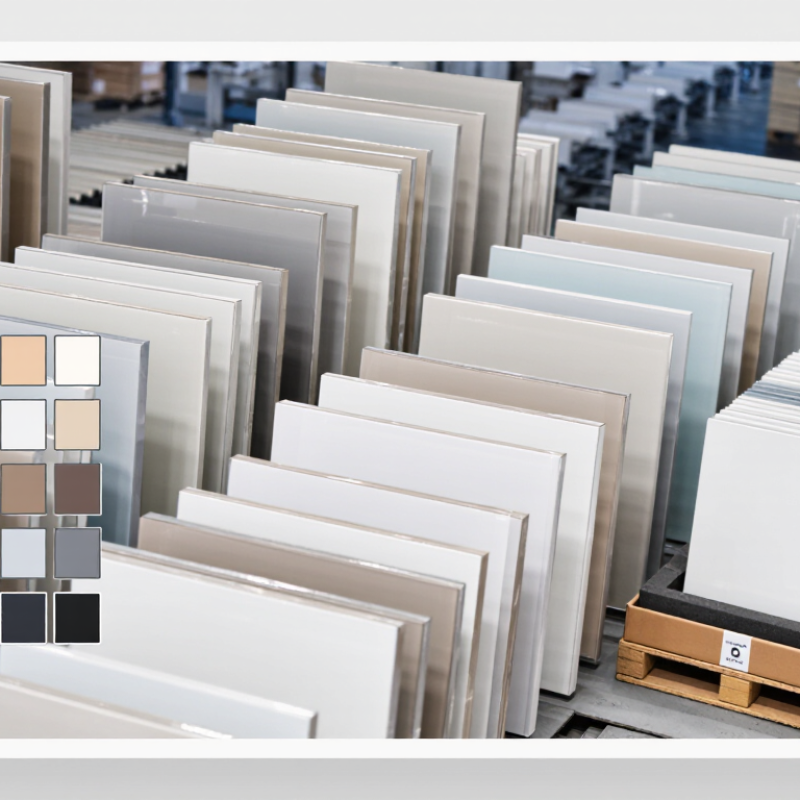
Top UV Board Manufacturers in China for Global Buyers

UV Boards Defined: Panel Substrates, Surface Layers, and Common Applications

An “UV board” is generally a wood-based panel finished with a coating cured by ultraviolet light. The name describes the surface treatment, not one fixed core. Common substrates include medium-density fibreboard, particleboard, and sometimes plywood. Each behaves differently: MDF offers a smooth face, while particleboard can be lighter or less costly. FAO’s Global Forest Products Facts and Figures 2022 reports global wood-based panel production of about 401 million cubic metres in 2022. That figure covers many panel types, not UV-finished boards specifically.

The surface typically includes a prepared panel face, one or more primer or colour layers, and a UV-cured clear or pigmented topcoat. Curing hardens the coating quickly under ultraviolet lamps, creating a smooth, often glossy finish. A glossy door shows fingerprints and fine scratches more clearly. Matte finishes can soften glare, though they are not automatically more scratch-resistant. Layer thickness, edge sealing, and coating consistency matter. “UV board” can be an imprecise trade description.

These panels are commonly used for cabinet doors, wardrobes, furniture fronts, and interior wall panels, where a consistent colour and easy-clean surface are useful. Check the substrate, finish, and edge treatment separately. A polished face cannot compensate for a poorly sealed edge or a core unsuited to the room’s moisture conditions. Even showroom samples may not reveal long-term wear; that deserves a closer look.

How UV Board Coatings Cure: Industrial UV Systems Typically Use 200–400 nm

UV board coatings cure when photoinitiators absorb ultraviolet energy and start polymerization. Industrial systems often operate across roughly 200–400 nm, but the effective band depends on the coating formulation. ISO 21348:2007 places UVA at 315–400 nm, UVB at 280–315 nm, and UVC at 100–280 nm. That matters. A lamp may deliver strong output yet cure poorly if its wavelengths do not match the photoinitiator’s absorption range.

In production, wavelength is only part of the process. Operators also control irradiance, exposure time, lamp distance, and coating thickness. A handheld UV radiometer can check output at the board surface, while a tack test can reveal incomplete curing. Dark pigments and recessed edges may block energy. A smooth surface can still hide uncured material beneath it.

For global buyers comparing UV board suppliers, request wavelength and dose records from the actual production line, not just a lamp specification. Ask how the supplier checks cure consistency across a full panel. Small variations matter. I would not treat 200–400 nm as one universal recipe; coating chemistry and line speed can change the result. A neat specification sheet can still leave unanswered questions.

Top UV Board Manufacturers in China for Global Buyers — How UV Board Coatings Cure: Industrial UV Systems Typically Use 200–400 nm
Evaluation Dimension Technical Data Why It Matters to Buyers What to Verify with the Supplier
UV wavelength range Ultraviolet radiation is commonly defined as wavelengths from 100 to 400 nm. Industrial UV coating systems commonly use output within the 200–400 nm region, depending on the lamp, coating, and process. The coating’s photoinitiator must absorb the wavelengths delivered by the curing equipment for effective curing. Request the lamp or LED emission spectrum and confirm that it overlaps with the coating’s recommended absorption range.
Common UV regions UVA: 315–400 nm; UVB: 280–315 nm; UVC: 100–280 nm. Many surface-coating processes rely mainly on UVA, with the specific spectrum determined by the formulation and equipment. Different wavelength regions interact differently with coating ingredients and may affect surface cure, through-cure, and substrate exposure. Ask which UV region is used and whether the coating supplier has validated the formulation for that spectral output.
Typical lamp and LED outputs Medium-pressure mercury lamps produce multiple spectral lines and a broad output. UV LED systems commonly use nominal wavelengths such as 365, 385, or 395 nm; actual output is specified by the equipment supplier. A nominal wavelength alone does not describe the full spectrum or confirm that a coating will cure correctly. Obtain the spectral distribution, operating distance, lamp or LED configuration, and compatibility guidance for the coating.
UV irradiance Irradiance is the UV power arriving at a surface, commonly reported in W/cm² or mW/cm². The required value varies with the coating, wavelength, line speed, and equipment geometry. Insufficient irradiance can result in incomplete curing; excessive exposure may affect appearance or heat-sensitive materials. Request measured irradiance at the board surface under production conditions, not only the equipment’s rated output.
UV dose Dose, also called radiant exposure, is energy received per unit area and is commonly reported in mJ/cm². It depends on irradiance and exposure time. Dose helps compare curing conditions, but it must be considered together with wavelength and formulation. Ask for the validated dose range and the measurement method used for the finished coating system.
Coating cure mechanism In many UV-curable coatings, photoinitiators absorb UV energy and generate reactive species that start polymerization. Formulations may use free-radical or cationic curing chemistry. Coating chemistry influences wavelength sensitivity, cure behavior, and compatibility with the board and production process. Confirm the coating chemistry, recommended curing spectrum, and test results for the intended board surface.
Board substrate and surface UV coatings may be applied to engineered wood panels and other prepared substrates. Surface preparation, coating thickness, color, and substrate condition can affect the curing result. Differences in surface absorption, coating opacity, or panel preparation can change the amount of UV reaching the coating. Request samples made with the specified substrate, surface finish, coating system, and production settings.
Production-line validation Cure performance depends on the combined process: spectral output, irradiance, dose, coating formulation, coating thickness, line speed, and equipment setup. Published equipment specifications alone cannot guarantee that a finished UV board will meet the buyer’s requirements. Agree on inspection criteria and verify cure, adhesion, hardness, appearance, and other required properties on production-representative samples.
Safety and equipment controls UV exposure can harm eyes and skin. Enclosed curing units, shielding, interlocks, and suitable personal protective equipment are standard risk controls. Appropriate controls protect workers and support safer operation and maintenance. Review the equipment safety documentation, guarding, interlock arrangements, ventilation, and maintenance procedures.
Technical values are general reference information. The appropriate curing conditions depend on the specific coating formulation, board construction, and production equipment; confirm them through supplier documentation and process testing.

Leading Chinese Manufacturers: Compare Product Ranges, Capacity, and Export Reach

Chinese UV board manufacturers vary in substrate choices, surface finishes, and production scale. Some focus on MDF or plywood panels, while others offer several thicknesses, gloss levels, and decorative patterns. Compare technical data sheets, not just catalog photos. Request samples under consistent lighting. Small details matter.

Capacity matters when schedules are tight, but a monthly figure alone says little about reliable output. Check production lines, typical lead times, minimum order quantities, and repeat-order procedures. Request recent inspection records and confirm tolerances for thickness, coating uniformity, and edge quality. A polished sample may not represent every batch.

Assess export reach by asking which markets a manufacturer serves and how it packs products for shipment. Confirm whether boards receive corner protection and moisture barriers for long ocean transit. Clarify how claims, replacements, and production changes are handled across time zones. Comparisons can be messy; clear documentation is often more useful than confident sales language.

Formaldehyde Benchmarks: GB/T 39600-2021 Sets ENF at ≤0.025 mg/m³

For global buyers comparing UV board manufacturers in China, the ENF benchmark deserves close attention. Under GB/T 39600-2021, ENF denotes formaldehyde emissions of no more than 0.025 mg/m³. That figure is a useful reference, not a substitute for checking the product itself. Ask for a current test report covering the exact board type, thickness, and production specification.

A UV-cured surface can look smooth and glossy under warehouse lighting. Yet the core material and its adhesive system also matter for emissions. Request the test method, sampling details, and laboratory information, then confirm that the report matches the panels being quoted. Details matter. A report for one construction may not represent another, even when both carry a similar finish.

For shipments, buyers can also request batch identification and retain samples for incoming inspection. Check that packaging and storage have not caused visible damage or surface variation. The ENF limit is precise, but test conditions and documentation need careful reading. I would not judge a supplier by one number alone; sometimes the paperwork looks cleaner than the purchasing process. That is worth reflecting on.

Global Buyer Checklist: Verify Certifications, Test Reports, Samples, and Lead Times

Top UV Board Manufacturers in China for Global Buyers

A supplier’s certificate is useful only when its scope matches the board you plan to buy. Check the product type, factory location, issuing body, and validity date. Check the scope carefully. Requirements can differ by market and application, so confirm which documents your own project needs rather than relying on a generic company certificate.

Ask for test reports covering the exact grade, thickness, and surface finish in your quotation. Review the test method, report date, sample identification, and laboratory details. If the report describes a different specification, request clarification. Then order samples from the intended production line. Inspect color, flatness, cut edges, and surface adhesion in ordinary daylight and under your expected lighting. A sample helps, but it cannot guarantee every production batch. It can still vary.

Get lead times in writing, including sample approval, production, inspection, packing, and dispatch. Ask which stages depend on material availability or factory capacity, and confirm how delays will be communicated. A very short estimate may exclude inspection or packing time. I would not rely on a quick verbal promise; buyers sometimes do, and later regret it. Request a dated schedule with clear milestones before placing a large order.

Top UV Board Manufacturers in China: Global Buyer Checklist

Verification points to review before placing an order. Values show the number of checks in each category, not market statistics.

What to verify: Confirm certification issuer, validity, scope, and product or factory coverage. Check test-report lab accreditation, methods, product match, and report date. Inspect sample color, surface, and dimensions. Get separate sample, production, and shipping lead times in writing.

bottom of page