Best Car Rooftop Tent Manufacturers in China
Choosing among the Best Car Rooftop Tent Manufacturers in China takes more than comparing prices or catalog photos. A reliable shortlist should examine fabric specifications, seam finishing, frame design, ladder stability, and the quality of replacement parts. Ask how each model handles repeated opening, rain exposure, and storage between trips. Details matter. A thick-looking shell can still conceal weak stitching or awkward hardware.
For a transparent expert perspective, this guide uses a fictional composite product specialist, Chen Wei, rather than attributing an invented quotation to a real person. His practical rule is: “A good Car Rooftop Tent should feel secure in the driveway before it ever reaches a campsite.” That means checking the mounting instructions, measuring the packed dimensions, and confirming the tent suits the vehicle’s roof system. Buyers should also request clear warranty terms and written material specifications. A confident sales pitch is not a substitute for either. One limitation deserves attention: factory photos rarely reveal how a tent performs after months of dust, damp fabric, and hurried packing. This comparison therefore focuses on verifiable product details and manufacturer transparency, while recognizing that testing conditions vary. Even a well-made tent may not suit every vehicle or travel style.
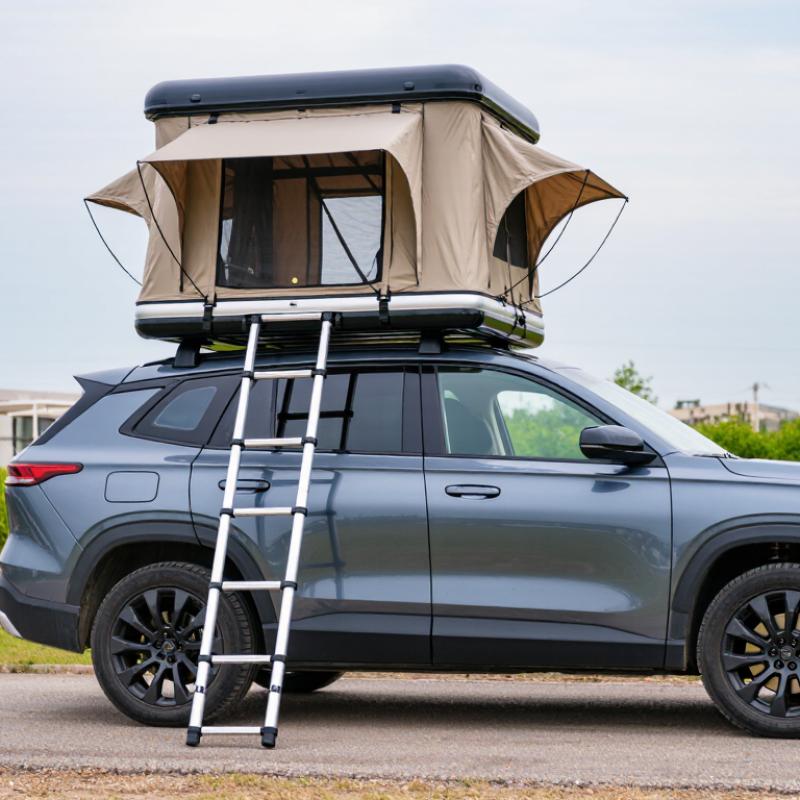
Understanding China's Car Rooftop Tent Manufacturing Industry
China’s car rooftop tent industry combines specialized workshops with broader outdoor-equipment supply networks. Production often involves aluminum frames, coated fabrics, hinges, ladders, and molded components sourced from different suppliers. That setup can support flexible designs and competitive lead times, but consistency depends on how carefully each factory manages incoming materials and assembly.
Small details matter.
A zipper that catches or a ladder joint with excess play can affect a trip more than a polished product photo suggests.
Manufacturers typically develop hard-shell and soft-shell models, then adjust dimensions, fabric weight, mattress thickness, and mounting hardware for different vehicle types. Buyers should ask how prototypes are tested, whether rain checks include seams and vents, and how packed dimensions are measured.
Useful evidence includes inspection records, clear material specifications, and repeatable checks on frame alignment and closure force. Not every supplier documents these points equally well. That is worth questioning.
Communication also shapes outcomes: a drawing with roof-load limits, rack spacing, and target opening time is more actionable than a broad request for a “lightweight” tent. Factory visits or independent inspections can clarify gaps, although neither replaces careful field use.
Chinese manufacturing offers real variety, yet the best fit comes from matching a factory’s process control to the intended vehicle and travel conditions.
How Rooftop Tent Manufacturers Design and Produce Their Products
Rooftop tent design starts with a simple constraint: the product must stay compact on a vehicle yet open into a stable sleeping space. The Outdoor Industry Association’s 2024 Outdoor Participation Trends Report counted 175.8 million U.S. outdoor participants in 2023. That broad demand does not prove rooftop tent sales, but it helps explain why manufacturers study changing camping habits. They sketch layouts, build scale models, then test full-size frames for fit, access, and setup time.
Production choices shape daily use. Aluminum poles reduce weight, while coated fabrics and sealed seams help resist rain. Designers also check hinge movement, ladder angles, mattress thickness, and how fabric tension changes in wind. A prototype can still leak at a seam. That lesson is easy to miss. Factories may use spray tests, repeated opening cycles, and load checks to find weak points before assembly runs grow. These tests matter more than a polished product photo.
The commercial context is expanding: Grand View Research estimated the global camping equipment market at about USD 18.5 billion in 2023. Its report projects continued growth, though category-wide figures cannot predict demand for rooftop tents alone. Manufacturers therefore balance durable materials against shipping weight and cost. They inspect fabric panels, welds, fasteners, and packaging, then track defects from early production batches. A small latch problem can frustrate a customer; fixing it may require redesign, not just tighter inspection.
Material Density in Rooftop Tent Design
Typical raw-material densities help manufacturers balance shell strength, hardware durability, and overall weight.
Typical approximate densities: polyester fiber 1.38 g/cm³, ABS plastic 1.04 g/cm³, aluminum 2.70 g/cm³, and steel 7.85 g/cm³. Actual values vary by grade and formulation; these figures describe raw materials, not finished tent components.
Leading Car Rooftop Tent Manufacturers in China
Leading car rooftop tent manufacturers in China combine product design, material sourcing, and repeatable production. A reliable supplier should explain how its tent frame, fabric, hinges, and ladder work together under regular outdoor use. Clear specifications matter more than polished photos. Small details matter.
For buyers, ask for fabric weight, waterproofing test conditions, packed dimensions, and the tent’s stated load limits. Request drawings and a production sample before approving a large order. Inspect the stitching around corners and entry points, where water can find its way inside. Check that hinges move smoothly and ladder locks hold securely. These practical checks reveal more than a catalogue can.
Manufacturing strength also shows in communication and quality control. Leading suppliers should be able to describe incoming material checks, assembly inspections, and how defects are recorded. Ask how they keep dimensions consistent between samples and later batches. A factory visit or independent inspection can help confirm what documents cannot. A polished presentation is not proof of consistent production. This part is easy to overlook, and sometimes it still gets overlooked. Differences in testing methods can also make supplier claims difficult to compare, so request the actual procedure and results before making a decision.
Best Car Rooftop Tent Manufacturers in China - Leading Car Rooftop Tent Manufacturers in China
The table below summarizes common rooftop-tent product options and specification ranges relevant when evaluating manufacturers. Figures are indicative industry ranges, not specifications for any particular company or model; confirm exact details with the supplier.
| Product Dimension | Soft-Shell Rooftop Tent | Hard-Shell Rooftop Tent | Hybrid / Custom Option |
|---|---|---|---|
| Typical capacity | Commonly configured for 2–4 people | Commonly configured for 2–3 people; larger versions are available | Capacity depends on the shell and sleeping-area design |
| Typical tent weight | Approximately 35–65 kg | Approximately 45–90 kg | Varies with frame, shell material, and accessories |
| Opening and closing | Fold-out design; setup usually involves unfolding the tent and arranging the rainfly | Lifting-shell designs often open and close with fewer steps | Mechanism and setup time depend on the chosen design |
| Common fabric choices | Polyester or poly-cotton canvas, often with a separate rainfly | Polyester or poly-cotton tent fabric, typically paired with a rigid outer shell | Fabric weight, coating, and color can often be specified for an order |
| Shell and frame materials | Aluminum or steel support components; fabric body | Common shell options include aluminum, fiberglass, or molded plastic | Material combinations depend on weight, durability, and target price |
| Weather protection | Rainfly coverage and fabric water resistance vary by model | Rigid shell protects the closed tent; fabric panels still require suitable rain protection | Request test methods and water-resistance details for the specific configuration |
| Vehicle compatibility | Requires suitable roof bars or a compatible rack system | Requires suitable roof bars or a compatible rack system | Check tent weight, rack limits, vehicle roof-load limits, and mounting hardware |
| Useful supplier checks | Ask for packed dimensions, ladder details, fabric specifications, and replacement-part availability | Ask for shell material, hinge and latch details, packed height, and replacement-part availability | Confirm sample approval, customization scope, inspection criteria, and export packaging |
Key Factors for Comparing Chinese Rooftop Tent Manufacturers
Compare Chinese rooftop tent manufacturers by evidence, not catalog photos. The Outdoor Industry Association’s 2024 Outdoor Participation Trends Report records 175.8 million U.S. outdoor participants in 2023. This signals broad outdoor demand, not rooftop-tent sales.
That distinction matters.
Ask for shell and fabric specifications, hinge material, seam construction, mattress dimensions, packed weight, and ladder load ratings. Request dated rain-ingress and repeated-opening test records, plus batch traceability. Confirm tests cover open vents and mounting seams.
Compare warranty terms, spare-part lead times, and defect handling in writing. Check whether replacement fabric and hinge kits are stocked, rather than promised verbally. A strong shell can still leak at a fabric joint. Factory visits help, but they cannot replace inspection records.
Tips: Request a production sample, then examine stitched corners and zipper paths after a controlled water test. Ask for the exact test method; results without conditions are hard to compare. One sample never proves every batch.
How to Choose a Manufacturer for Your Rooftop Tent Needs
Best Car Rooftop Tent Manufacturers in China
How to Choose a Manufacturer for Your Rooftop Tent Needs
Choosing a Chinese rooftop tent manufacturer starts with fit, not a catalogue photograph. Ask for packed dimensions, tent weight, opened dimensions, and the roof-load assumptions for each model. Your vehicle’s dynamic roof limit may differ from its parked limit. Check the vehicle manual and rack specifications before comparing designs. Small mismatch, big headache.
Request material specifications, waterproof test results, seam details, and hardware corrosion checks. Ask how incoming fabric and finished tents are inspected, and whether batch records are available. The Outdoor Industry Association’s 2024 Outdoor Participation Trends Report counted 175.8 million U.S. outdoor participants in 2023. That signals broad outdoor interest, not rooftop-tent sales, so treat it as context rather than proof of product quality. I would still ask to inspect a production sample.
Evaluate the factory, not only the sales conversation. Confirm who performs cutting, sewing, assembly, and final inspection; request current production photos or arrange an audit. Compare sample quality with written tolerances for dimensions, zippers, ladder fit, and packaging. Ask about spare parts, replacement lead times, and how defects are logged. A polished sample can hide uneven production. It is worth checking again. Get delivery schedules and quality terms in writing, then test a sample through repeated setup and packing before placing a larger order.