What Is a Filter Funnel and Which Type Should You Choose?
Choosing a Filter Funnel looks simple until the liquid slows, the paper collapses, or valuable solids disappear into the waste container. In laboratory work, the funnel is not merely a holder for filter paper. Its design controls flow, pressure, particle retention, and the condition of the final sample.
Warren L. McCabe, a leading chemical engineering educator, described filtration as “the separation of a suspension into a solid filter cake and a liquid filtrate by passing the suspension through a filter medium.” That definition remains practical. It points directly to the two results every user must evaluate: the collected solid and the clarified liquid.
A gravity Filter Funnel suits routine separations with moderate volumes and stable particles. It needs little equipment. It also needs patience. A Büchner funnel, paired with vacuum filtration, is better for faster solid recovery and drier filter cakes. A sintered-glass funnel can help when paper fibers might contaminate the sample, although cleaning requires greater care. Pressure funnels may handle difficult slurries, but they demand closer control and appropriate laboratory safeguards.
The best choice depends on the material, not personal habit. Consider viscosity, particle size, temperature, chemical compatibility, and the required dryness. A wide funnel may reduce clogging. A smaller pore size may improve clarity but sharply reduce flow.
There is no perfect funnel.
Even experienced technicians sometimes choose a faster setup and regret it later. A useful decision begins with the desired outcome: clean liquid, recoverable solid, or both. This guide examines each Filter Funnel type, its strengths, its limitations, and the practical details that influence reliable filtration.
What Is a Filter Funnel and How Does It Work?
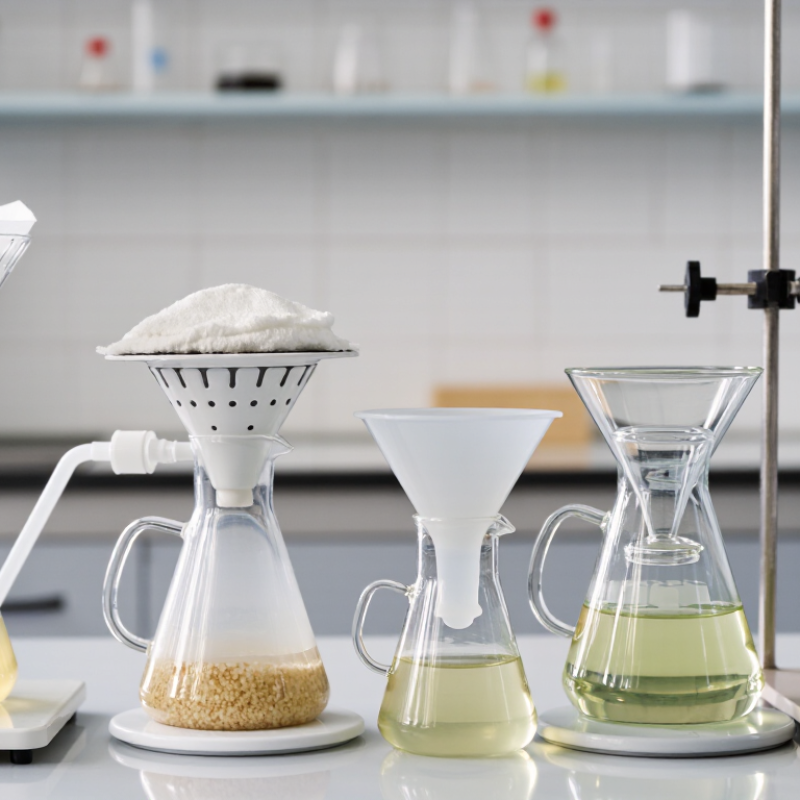
A filter funnel holds filter paper or a membrane while liquid passes through and solids remain behind. In gravity filtration, liquid moves through the medium because of its own weight. The funnel’s narrow stem directs the clearer liquid into a receiving vessel.
Vacuum filtration uses reduced pressure beneath the filter. This pressure difference pulls liquid through faster than gravity alone. A perforated Büchner-style funnel suits larger solid residues and flat filter papers. A Hirsch-style funnel works better for smaller samples.
For routine liquid clarification, choose a standard conical funnel with suitable filter paper. The pore size matters more than appearance.
The U.S. EPA Method 160.1 specifies filtration through a glass-fiber filter with a nominal 1.5-micrometer retention size. It then dries the captured material at 103–105°C for gravimetric measurement. That detail shows how filtration depends on controlled conditions, not just funnel shape. The WHO/UNICEF Joint Monitoring Programme reported that 2.2 billion people lacked safely managed drinking water in 2022. Filtration remains important, but a laboratory funnel cannot make unsafe water automatically safe.
In practice, wet the paper first. Seat it carefully. A small gap can let particles bypass the filter. I have found that rushing this step causes more errors than choosing the wrong funnel. Even a clean setup can mislead you. Surface cleanliness, flow rate, sample volume, and filter compatibility still need checking.
What Are the Main Types of Filter Funnels?
A filter funnel separates solids from liquids while the mixture passes through a porous barrier. The correct design depends on volume, particle size, solvent, and required speed. A basic gravity funnel suits routine clarification and small batches. Its conical shape directs liquid into a receiving vessel, while folded filter paper holds the solid residue. It is simple, gentle, and easy to inspect.
A Büchner funnel uses vacuum suction through a flat perforated plate. It works well when crystals must be collected quickly and washed with limited liquid. Use a matching filter disc, a secure seal, and a flask designed for reduced pressure.
A Hirsch funnel follows the same principle but has a smaller surface area. It is better for valuable products or small crystal samples. I have found that poor paper placement causes more trouble than slow suction.
A sintered-glass funnel contains a fixed porous glass filter. It avoids loose paper and can handle repeated filtration when the material is chemically compatible. However, blocked pores are difficult to clean, and sudden temperature changes may damage the glass.
Pressure funnels can process larger volumes, but they require careful control of pressure and vessel strength. Choose the least aggressive method that meets your time target. Fast filtration is not always cleaner. A pilot test with a small sample can reveal clogging, solvent incompatibility, or unexpected product loss before the full batch.
Which Materials and Designs Suit Different Uses?
A filter funnel directs liquid through a porous medium while retaining unwanted particles. Its material and design should match the liquid, temperature, and filtration method. Choosing by appearance alone can cause leaks, contamination, or breakage.
Borosilicate glass suits laboratory work involving heat and clear visual inspection. It resists many chemicals, but it remains fragile. Stainless steel handles repeated use and rougher conditions. It cleans easily, although certain liquids can corrode it. Polypropylene works well with cool, mild solutions and offers useful impact resistance. For highly reactive liquids, PTFE can provide stronger chemical compatibility. Always check the manufacturer’s temperature and chemical-resistance data.
Design matters as much as material. A long, narrow stem reduces splashing and directs liquid into small containers. A wide funnel speeds transfer but may spill when the receiving vessel is narrow. Ribbed funnels can improve air release during gravity filtration. Vacuum funnels work faster, but only with compatible glassware and controlled pressure. Do not assume every plastic funnel is vacuum-safe.
A practical mistake is choosing the smallest funnel to save space. It often clogs sooner. In my view, a slightly wider filter area is usually easier to manage. Still, finer filtration may require a smaller pore size, slower flow, and more patience. Check the seal, fit, and filter medium before pouring.
What Is a Filter Funnel and Which Type Should You Choose? - Which Materials and Designs Suit Different Uses?
| Filter Funnel Type | Typical Material | Design and Filtration Method | Best-Suited Uses | Main Advantages | Important Limitations | Recommended Choice When... |
|---|---|---|---|---|---|---|
| Plain Gravity Filter Funnel | Borosilicate glass, polypropylene, or polyethylene | Conical funnel holding folded filter paper; liquid passes through under gravity. | Routine clarification, solvent transfer, removal of visible particles, and general laboratory filtration. | Simple, inexpensive, easy to clean, and suitable for many liquid volumes. | Slow for fine particles or large volumes; filter paper may clog quickly. | You need a versatile, low-pressure filtration setup for nonurgent work. |
| Long-Stem Filter Funnel | Glass or chemical-resistant plastic | A narrow, extended stem directs the filtrate into a receiving vessel and helps reduce splashing. | Filtration into narrow-neck flasks, bottles, or test vessels. | Improves positioning and controlled delivery into small openings. | The long stem can drain slowly and may retain liquid after filtration. | The receiving container has a narrow opening or splashing must be minimized. |
| Büchner Funnel | Porcelain, polypropylene, or borosilicate glass | Flat perforated plate supports a circular filter paper; vacuum below the funnel accelerates filtration. | Rapid separation of crystalline or particulate solids from liquids. | Faster than gravity filtration and effective for collecting solid products. | Requires a vacuum source, a suitable flask, and a secure airtight connection. | Speed is important and the retained solid forms a relatively broad filter cake. |
| Hirsch Funnel | Porcelain, glass, or polypropylene | Small perforated plate designed for vacuum filtration of limited quantities of solid. | Small-scale crystallization, microscale synthesis, and recovery of small solid samples. | Uses less filter paper and minimizes product loss in small batches. | Limited capacity; not appropriate for large volumes or substantial solid loads. | The sample is small and efficient solid recovery matters more than throughput. |
| Sintered-Glass Filter Funnel | Porous borosilicate glass | A permanently fused porous glass disc provides filtration without disposable filter paper. | Chemical filtration, gas dispersion, gravimetric work, and applications requiring low extractables. | Reusable, chemically resistant to many reagents, and produces consistent filtration. | Fragile, more difficult to clean after clogging, and unsuitable for substances that attack glass. | You need a reusable medium and the process is compatible with glass. |
| Fritted-Disc Filter Funnel | Sintered glass, sintered metal, or chemically resistant plastic | A porous disc is manufactured with a selected porosity; no separate filter paper is required. | Fine particulate removal, controlled laboratory separations, and repeated filtration tasks. | Offers repeatable pore characteristics and a clean, paper-free workflow. | A fine disc can clog easily; cleaning and drying require careful procedures. | You require a defined filtration medium and can maintain the disc properly. |
| Vacuum Filter Funnel with Membrane Support | Glass, stainless steel, polypropylene, or other compatible polymers | A membrane is clamped or supported over a porous base while vacuum pressure pulls liquid through. | Fine filtration, sample preparation, particle removal, and analytical laboratory work. | Can provide fine and reproducible separation with a wide range of membrane materials. | Membrane compatibility, pore size, pressure, and sealing must be selected correctly. | Small particles must be removed and a defined membrane pore rating is required. |
| Pressure Filter Funnel | Stainless steel, glass, or reinforced polymer | Positive pressure forces liquid through a filter medium inside a sealed housing. | Higher-throughput filtration, difficult-to-filter liquids, and processes where vacuum is unsuitable. | Can improve flow through dense filter media and reduce boiling or solvent evaporation caused by vacuum. | Requires pressure-rated equipment and careful control of sealing and operating pressure. | The liquid is viscous, the filter medium is dense, or vacuum filtration is inappropriate. |
How Do You Choose the Right Filter Funnel?
Choosing the right filter funnel begins with the sample, not the funnel’s appearance. In routine laboratory work, I match the funnel to the solid content, liquid volume, and required speed. A standard gravity funnel works well for small batches and gentle separation. A Büchner-style funnel is better when vacuum filtration must remove liquid quickly. Vacuum systems need compatible flasks, secure seals, and careful pressure control.
Filter material matters just as much. Glass suits many solvents and allows easy visual inspection. Plastic can be lighter and more resistant to accidental impacts, but compatibility varies. Check the material against the liquid’s temperature and chemical properties. Pore size also changes the result. Fine pores capture smaller particles but may clog quickly. Coarse pores filter faster, though some solids may pass through. I often wet the filter paper before adding the sample. This improves contact and reduces early bypass.
The funnel should fit the filter paper closely, without folded edges blocking the flow path. Choose a bowl large enough to avoid splashing, but not so large that the paper sits poorly. For heat-sensitive samples, avoid unnecessary vacuum and prolonged exposure. I have sometimes chosen the fastest setup and regretted it when the filter clogged halfway through. A slower funnel can protect the sample and save time. Always test a small portion when compatibility or particle size is uncertain. Small details matter.
What Is a Filter Funnel and Which Type Should You Choose?
A filter funnel supports filter paper or another filter medium so a solid–liquid mixture can be separated. The best choice depends mainly on filtration speed, sample volume, particle recovery, and whether vacuum can be used.
How to choose: Use a gravity funnel for routine filtration and gentle handling. Choose a Büchner funnel when faster vacuum filtration is needed for larger solid residues. A Hirsch funnel is suited to small samples and small quantities of crystals. A sintered-glass funnel is useful when avoiding disposable filter paper or when chemical resistance and cleanability are important.
How Should a Filter Funnel Be Used and Maintained?
What Is a Filter Funnel and Which Type Should You Choose?
A filter funnel is a simple tool for separating solids from liquids during laboratory or workshop tasks. Its shape supports controlled pouring and helps reduce spills. Choose a standard funnel for gravity filtration and routine transfers. A vacuum-compatible funnel works better when faster separation is needed. Match the funnel size to your filter paper and receiving vessel. A funnel that is too large may waste material. A narrow stem can also slow drainage.
How Should a Filter Funnel Be Used and Maintained?
Inspect the funnel before use. Check for cracks, blocked openings, or rough edges. Fold the filter paper correctly, then wet it slightly so it seats against the funnel wall. Pour slowly along a glass rod or the funnel side. Keep the liquid below the paper’s upper edge. This small detail prevents overflow. I have found that rushing this step causes more mess than expected.
After use, empty trapped solids safely and rinse the funnel immediately. Dried residue becomes difficult to remove. Wash with a compatible laboratory detergent, then rinse with clean water. Allow the funnel to dry fully before storage. Do not scrape delicate surfaces with metal tools.
Tips: Keep separate funnels for different materials when cross-contamination matters. Label them clearly. Inspect the stem before every session. It is easy to overlook. Avoid forcing a blocked funnel; gentle rinsing is usually safer. When results seem inconsistent, check the paper fit, liquid viscosity, and funnel cleanliness before changing the procedure.