top of page

Call Ahead! 262.242.1050

ask for an appointment with Dave or Emily!

​

​

What Is the Best Wireless Lock from China for Global Buyers?

Choosing the best Wireless Lock from China requires more than comparing prices or counting app features. Global buyers need evidence, field experience, and dependable support. A lock may look impressive in a factory showroom, yet fail after winter temperatures drain its batteries. That detail matters.

China offers a broad manufacturing base for smart cylinders, cabinet locks, hotel locks, and access-control systems. Experienced suppliers can provide OEM development, firmware customization, multilingual apps, and export packaging. However, product quality varies sharply between factories. A polished sample does not prove stable production. Ask for test reports, material specifications, battery-life data, and documented quality-control procedures.

Security must remain central. Bruce Schneier, a respected security technologist, said, “Security is a process, not a product.” His point applies directly to every Wireless Lock purchase. Buyers should examine encryption, administrator permissions, offline access, software-update policies, and data handling. Physical strength matters too. Check the lock body, cylinder resistance, emergency power method, and installation tolerances.

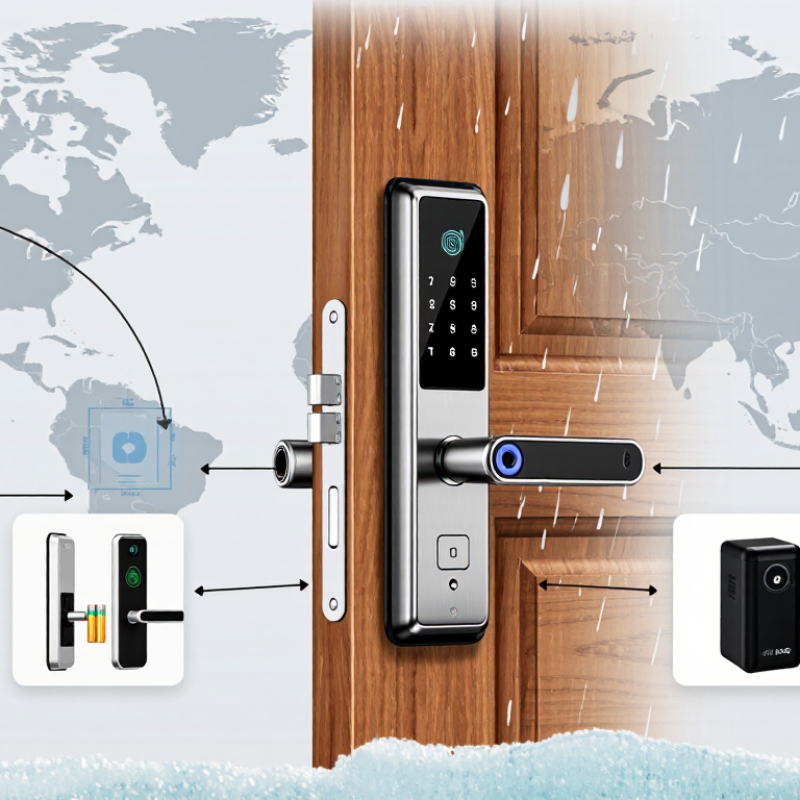
Do not overlook compatibility. Door thickness, mortise dimensions, network frequency, and regional power standards can create expensive surprises. Request installation samples before placing a large order. Test them in real conditions. Include dust, rain, weak signals, and repeated daily use.

The “best” option is rarely the cheapest one. It is the supplier that combines verified security, consistent manufacturing, responsive after-sales service, and clear international documentation. Still, no evaluation is perfect. Buyers should challenge their own assumptions, because a Wireless Lock that succeeds in one market may require careful redesign elsewhere.

What Is the Best Wireless Lock from China for Global Buyers?

Wireless Lock Types Available from China for Global Buyers

For global buyers, China offers several wireless lock types, each suited to a different access environment. Bluetooth Low Energy locks work well for apartments, offices, and rental units. They usually consume less power and can operate near the door without constant internet access. Wi-Fi locks support remote unlocking, cloud alerts, and video intercom integration. However, their batteries may drain faster. Choose carefully.

Zigbee, Z-Wave, and Thread locks connect through a hub or smart-home gateway. They suit larger properties requiring stable mesh communication. Cellular locks serve gates, storage sites, and locations without fixed internet, but subscription costs need careful review. Fingerprint, PIN, RFID, and NFC are credential methods, not wireless protocols. This distinction matters during product comparison.

Market data supports the sector’s momentum. Grand View Research valued the global smart locks market at about 2.21 billion US dollars in 2022, with a projected 19.6% CAGR from 2023 to 2030. MarketsandMarkets estimated growth from 2.7 billion dollars in 2023 to 6.2 billion dollars by 2028. Definitions vary between reports, so buyers should not treat forecasts as guarantees. In sourcing projects, test battery life, firmware updates, encryption, cloud-region options, and mechanical compatibility with local door standards. Check samples under weak Wi-Fi and cold conditions. A polished sample can still hide poor after-sales support. That is an uncomfortable lesson. Reliable suppliers should provide test records, spare parts, clear warranties, and documentation for regional compliance.

Key Features That Define the Best Wireless Lock

For global buyers, the best wireless lock is defined by dependable performance, not a polished exterior. During installation checks, I look for stable wireless communication through doors, walls, and changing temperatures. A strong lock should support encrypted data and secure user authentication. It should also record access events clearly, with accurate times and user details.

Battery performance deserves careful attention. A reliable model should provide low-power operation and early battery warnings. Emergency power access is useful when a battery fails unexpectedly. Mechanical backup access can also prevent unnecessary service delays. Small details matter. The installation process should be simple, with adjustable fittings for different door thicknesses. Poor alignment, however, can reduce security and shorten motor life.

Global buyers should examine weather resistance, operating temperature, and tested load capacity. Independent testing documents are more valuable than vague sales claims. Technical support should offer clear manuals, replacement parts, and responsive communication across time zones. Data handling also requires review, especially when an application stores access records. I once underestimated this issue and focused too heavily on unlocking speed. That was a mistake. The better evaluation includes privacy settings, firmware updates, compatibility, and long-term maintenance costs. A wireless lock may perform well during the first week, yet reveal weaknesses after months of daily use. Real-world reliability needs patience.

How to Evaluate Chinese Wireless Lock Manufacturers

Choosing the best wireless lock from China begins with evaluating the manufacturer, not the catalog photograph. MarketsandMarkets estimated the smart lock market at USD 2.3 billion in 2023, with strong growth expected through 2028. That growth attracts capable factories and opportunistic sellers. Global buyers should request business licenses, export records, production photos, and recent audit reports. A factory visit, physical or virtual, can reveal wiring quality, storage conditions, and testing discipline.

Security deserves measurable evidence. Ask which wireless protocols are supported, how encryption keys are managed, and whether firmware updates are signed. The 2024 Verizon Data Breach Investigations Report found that the human element remained involved in 68% of breaches. Staff access and account controls matter. Require independent test reports for battery endurance, weather resistance, radio performance, and emergency entry. Relevant standards may include ISO 9001 systems, IP ratings, and region-specific electrical requirements. Certifications alone are not enough.

Test samples under realistic conditions. Install several units on metal, wood, and uneven doors. Check response time after weak-signal events. Measure battery performance during repeated daily use. Ask for failure rates, warranty terms, spare-part availability, and support response times. One weakness in my own evaluation is trusting polished documentation too quickly. A manufacturer may pass a sample test yet struggle with consistent mass production. Compare pre-shipment inspection results with delivered units. Small details matter: clear manuals, stable mobile software, and packaging that survives a long sea journey. Fresh evidence beats impressive promises.

What Is the Best Wireless Lock from China for Global Buyers? — How to Evaluate Chinese Wireless Lock Manufacturers
Evaluation Dimension Recommended Weight What Global Buyers Should Verify Evidence to Request from the Manufacturer Practical Acceptance Benchmark Relevant Standard or Regulatory Reference
Wireless Connectivity 12% Supported wireless technologies, operating frequency, communication range, gateway dependency, local fallback operation, and interoperability with the buyer’s access-control platform. Protocol specification, frequency declaration, integration guide, interoperability test report, and a live demonstration under realistic installation conditions. The wireless technology and frequency must be legal in every target market; the lock should retain a defined local access method if the network or gateway is unavailable. Radio-equipment requirements differ by jurisdiction. In the European Union, applicable products may fall under the Radio Equipment Directive 2014/53/EU; local spectrum rules must also be checked.
Regional Compliance 15% Whether the complete lock system—not only the wireless module—has the approvals required for the destination market. Declaration of Conformity, test reports from competent laboratories, technical file references, labeling samples, and country-specific import documentation. Documentation must identify the exact model, hardware revision, radio configuration, applicable directives, and test standards. A generic certificate without model traceability should not be accepted. Common references include RED 2014/53/EU, FCC equipment authorization requirements in the United States, UK radio-equipment rules, and applicable electrical-safety requirements.
Mechanical Compatibility 12% Door thickness, backset, center distance, spindle arrangement, handing, cylinder format, mortise dimensions, fire-door suitability, and compatibility with local door hardware. Dimensioned mechanical drawings, installation templates, door-preparation requirements, tolerance limits, and samples installed on representative doors. The supplier should provide a documented fit matrix and confirm compatibility before mass production; field modification of doors should not be the normal installation method. For electromechanical locks, EN 14846 provides a recognized European reference for mechanically operated locks and striking plates.
Security and Credential Control 15% Credential enrollment, authentication method, administrator roles, lost-device handling, audit logs, encryption in transit and at rest, and protection against replay or unauthorized pairing. Security architecture, threat model, key-management description, penetration-test summary, firmware-signing process, vulnerability-reporting channel, and sample audit logs. The system should support unique user credentials, role-based administration, revocation of lost credentials, encrypted communications, signed firmware, and an auditable event history. ISO/IEC 27001 concerns information-security management; ETSI EN 303 645 is a relevant baseline for cybersecurity in consumer IoT products where applicable.
Battery and Power Resilience 10% Battery chemistry, rated operating conditions, low-battery warning, emergency power method, battery-replacement process, and behavior during power loss. Battery test protocol, environmental test results, low-voltage thresholds, emergency-unlock instructions, and measured results from representative production units. The product should provide an early low-battery warning, a documented emergency access method, and a replacement procedure that does not damage the lock or erase authorized credentials. Battery life is application-dependent and should be validated using a stated usage profile rather than an unsupported single headline figure.
Environmental Protection 8% Resistance to dust, water, humidity, temperature variation, corrosion, and outdoor exposure for the complete installed assembly. Ingress-protection test report, operating-temperature range, humidity and corrosion test results, gasket specifications, and installation limitations. The stated IP rating must apply to the tested configuration. For example, IP65 means dust-tight protection and protection against water jets, but it does not by itself prove suitability for immersion or every outdoor condition. IEC 60529 defines IP-code protection levels. The correct rating depends on the lock’s location and the enclosure actually tested.
Durability and Lifecycle 10% Mechanical cycle life, latch or bolt endurance, clutch performance, keypad or reader durability, corrosion resistance, and spare-part availability. Endurance-test method, cycle count, failure criteria, component life data, spare-parts list, and warranty terms for the exact model. Testing should use production-equivalent units and disclose load, alignment, temperature, door type, and failure criteria. A cycle count without test conditions is not sufficient for comparison. EN 14846 includes classification and performance concepts relevant to electromechanical locks; project-specific requirements may require additional testing.
Factory Quality System 8% Incoming inspection, process controls, final inspection, software-version control, traceability, nonconformance handling, and corrective-action procedures. Current quality-management certificate, audit summary, inspection plan, sample control records, serial-number traceability, and corrective-action report with sensitive information removed. The quality system should cover the actual manufacturing site and product scope. ISO 9001 certification is useful evidence of a management system but is not proof that every lock is safe or reliable. ISO 9001 specifies requirements for a quality-management system; it does not certify product performance or cybersecurity.
Software, Cloud, and API Support 5% Mobile-app support, cloud hosting region, API availability, data export, account ownership, service continuity, update policy, and integration with property-management systems. API documentation, service-level terms, data-processing terms, update policy, supported operating systems, backup procedures, and exit plan for account or platform migration. Buyers should be able to export essential access records, identify data-processing locations, and operate critical access functions if cloud service is interrupted. Privacy and data-transfer obligations depend on the countries involved; contract terms should address personal data, retention, deletion, and breach notification.
Customization and Documentation 3% Language support, firmware configuration, packaging, labeling, access modes, mechanical variants, and documentation quality. Product-change procedure, engineering-change notice process, multilingual manuals, installation videos, packaging artwork, and configuration-management records. Any change to radio components, firmware, battery type, enclosure, or locking mechanism should trigger documented review and, where necessary, renewed compliance testing. Regulatory conformity generally applies to the product configuration that was assessed; undocumented substitutions can invalidate previous test evidence.
Commercial and After-Sales Capability 2% Minimum order quantity, lead time, sample policy, warranty response, replacement parts, technical support, training, and long-term product availability. Quotation with Incoterms, production lead-time schedule, warranty policy, service-contact details, spare-parts plan, and references to completed projects without relying only on marketing claims. The supplier should provide a clear escalation path, defined response times, replacement procedures, and written notice for end-of-life or major firmware changes. Commercial terms are contractual rather than universal technical standards and should be evaluated alongside total cost of ownership.
Scoring method: Assign each manufacturer a score from 0 to 5 for every dimension, multiply the score by the recommended weight, and compare the weighted totals only after confirming mandatory safety, radio, privacy, and mechanical requirements.

Global Standards, Security, and Compatibility Requirements

What Is the Best Wireless Lock from China for Global Buyers?

Global Standards, Security, and Compatibility Requirements

The best wireless lock is not always the cheapest model. Global buyers should verify the intended market first. A lock for Europe may require testing under EN 14846 or EN 15684, depending on its design. North American projects may require access-control compliance under UL 294. Wireless functions also need regional radio approvals, such as CE, FCC, or equivalent certifications. Ask for complete test reports, not only certificate images.

Security must cover the entire system. Verizon’s 2024 Data Breach Investigations Report found that human involvement appeared in 68% of breaches. Poor administrator controls can therefore weaken a well-built lock. IBM’s 2024 Cost of a Data Breach Report placed the global average breach cost at 4.88 million dollars. Encryption, secure firmware updates, unique credentials, and audit logs deserve close inspection. A strong cylinder cannot fix weak cloud security.

Compatibility is often the practical failure point. Confirm support for Bluetooth, Wi-Fi, gateways, mobile credentials, and existing access software. Check API documentation and offline operation. Test battery life with realistic daily cycles, not laboratory claims. Cold warehouses and thick doors can reduce performance. I would also request penetration-test scope, vulnerability response procedures, and a software bill of materials. No report proves perfection. Supplier documentation can still be incomplete, and buyers should record those gaps before placing a large order.

Ordering, Testing, and Importing Wireless Locks from China

Wireless locks from China can offer strong value, but ordering requires more than comparing prices. Fortune Business Insights valued the global smart-lock market at about USD 2.49 billion in 2023. Its report projects approximately USD 5.94 billion by 2030. That growth attracts many factories and uneven quality. I ask suppliers for factory addresses, production photos, wiring diagrams, firmware details, and recent test reports. Samples should match the proposed production model.

Test the lock before discussing large quantities. Check Bluetooth or Wi-Fi range through concrete walls. Measure battery use during repeated locking cycles. Test emergency power access, keypad response, physical key operation, and failed-network behavior. Test it repeatedly.

My first sample worked well indoors but lost connection near metal doors. That small failure changed my evaluation checklist.

For commercial projects, request testing against relevant standards, such as EN 14846 or ANSI/BHMA A156.25, where applicable. Radio requirements may also involve regional approvals, including CE or FCC rules.

Import planning needs equal attention. Confirm carton dimensions, gross weight, spare parts, user manuals, and installation tools before payment. Battery-powered products may require UN 38.3 transport documentation. Ask the supplier to separate batteries when logistics rules require it. International Trade Centre data shows that product classification strongly affects customs duties and import procedures. Therefore, verify the HS code with a licensed customs professional in the destination country. Do not rely only on the factory’s suggested code. A pre-shipment inspection should check quantity, firmware version, finish, packaging, and every included accessory. Mistakes often hide in the accessories.

Article Source:

bottom of page